
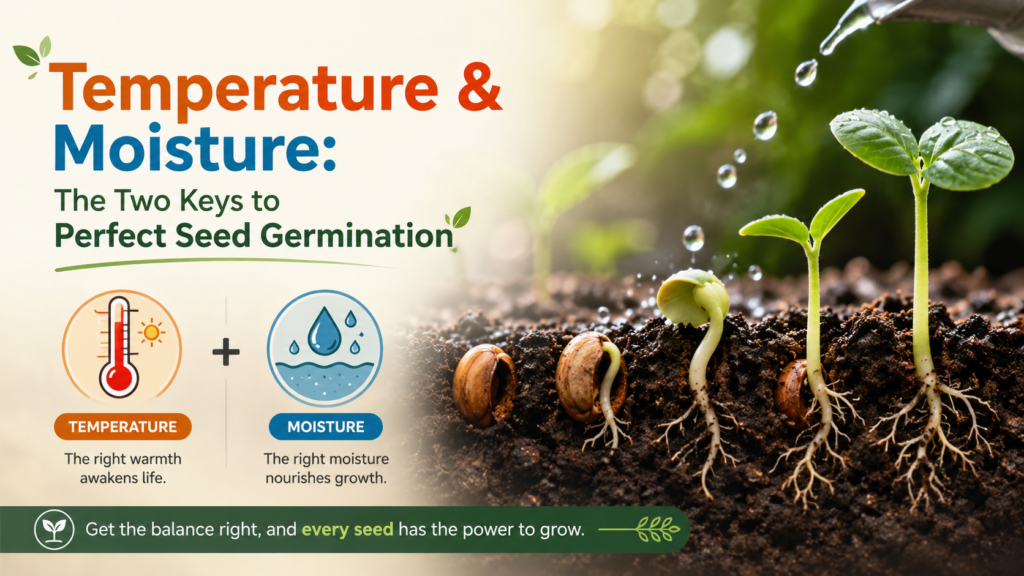
Every seed carries life within it — a tiny, dormant promise waiting for the right moment to wake up. But that moment doesn’t happen by chance. Behind every successful germination is a precise combination of two critical factors: temperature and moisture. Whether you’re a seed testing laboratory, an agricultural researcher, or a commercial seed producer, understanding how these two elements interact can mean the difference between accurate results and costly failures.
At Laxmi Industries, we’ve spent years working alongside seed scientists and agronomists, and we know that even the best seeds won’t perform without the right germination environment. Let’s break down exactly why temperature and moisture matter—and how the right seed germination paper can help you control both.
Why Temperature Is More Than Just a Number
Seeds are remarkably sensitive organisms. Each species has a specific temperature range within which it will germinate—too cold, and the seed stays dormant; too warm, and enzymes denature before the process can begin. Most crop seeds germinate optimally between 20°C and 30°C, but this varies significantly across species.
The Science Behind Thermal Sensitivity
Temperature directly influences enzymatic activity inside the seed. When the temperature falls within the optimal range, enzymes like amylases and proteases begin breaking down stored starches and proteins, fueling the growing embryo. This metabolic process is time-sensitive, which is why standard germination tests—such as those outlined by ISTA (International Seed Testing Association)—specify exact temperature conditions for each crop species.
Fluctuating temperatures during testing don’t just slow germination — they can cause abnormal seedling development, leading to misleading test results. For seed companies and regulatory labs, this means data integrity is tied directly to thermal consistency.
Alternating vs. Constant Temperatures
Interestingly, many seeds actually prefer alternating temperature cycles that mimic natural day-night rhythms. Research shows that seeds of certain grasses and native plant species germinate more uniformly under alternating temperatures (e.g., 20°C/30°C cycles) than under constant conditions. This is why modern germination cabinets offer programmable thermal cycles — and why your germination substrate needs to hold up across those fluctuations without degrading.
Moisture: The Trigger That Wakes the Seed
If temperature sets the stage, moisture pulls back the curtain. Water is the first physical signal a seed receives that conditions are right for growth. It activates imbibition — the process by which seeds absorb water, swell, and begin biochemical activity.
How Moisture Activates Germination
When a seed absorbs water, it rehydrates cellular structures, activates metabolic enzymes, and initiates the hormonal cascade—particularly gibberellin signaling—that breaks dormancy. Without adequate moisture, none of this happens. Too much moisture, on the other hand, creates anaerobic conditions that suffocate the emerging radicle and promote fungal growth.
The goal is consistent, controlled moisture — exactly enough to sustain the germination process without waterlogging the seeds.
Why Germination Paper Matters
This is where seed germination paper plays a defining role. A high-quality germination paper acts as a controlled moisture reservoir—absorbing water evenly, retaining it throughout the test period, and releasing it steadily to the seeds. Poor-quality paper either dries out too quickly or retains excess moisture unevenly, both of which compromise the reliability of your results.
At Laxmi Industries, our germination papers are engineered to maintain uniform water distribution across the entire substrate surface. They’re manufactured to ISTA and AOSA standards, ensuring consistent absorbency, appropriate thickness, and freedom from toxic substances that could inhibit germination. When your results depend on accuracy, the paper underneath your seeds isn’t a minor detail—it’s a critical variable.
Temperature and Moisture Working Together
Neither factor operates in isolation. Higher temperatures accelerate moisture evaporation, which means a germination test run at 30°C requires more careful moisture management than one at 20°C. Similarly, a substrate that retains water well at room temperature may behave differently inside a high-humidity germination cabinet.
This is why professional seed testing labs don’t leave either variable to guesswork. They combine calibrated equipment with certified germination paper — because every layer of the system needs to perform reliably for the final result to be trusted.
Conclusion
Seed germination is a precise science, and temperature and moisture are its two most powerful levers. Master these, and you create the conditions for consistent, reproducible results that seed producers, researchers, and certification bodies can rely on.
If you’re looking to strengthen your germination testing process from the substrate up, explore Laxmi Industries’ range of seed germination papers—designed for accuracy, consistency, and compliance with international testing standards.
👉 Visit laxmipaperind.com to explore our product range or get in touch with our team for technical guidance.
FAQs
Q1. What is the ideal temperature range for seed germination testing?
Most crop seeds are tested between 20°C and 30°C, though the optimal range varies by species. ISTA guidelines specify precise temperature requirements for each crop to ensure standardised, comparable results across laboratories.
Q2. How does germination paper help with moisture control?
Germination paper is designed to absorb and retain water evenly, providing seeds with a consistent moisture supply throughout the test period. Quality paper prevents both drying out and waterlogging — two common causes of inaccurate germination test results.
Q3. Can fluctuating temperatures affect seed germination test accuracy?
Yes. Uncontrolled temperature fluctuations can cause uneven or abnormal seedling development, leading to unreliable test data. Maintaining stable or precisely programmed alternating temperatures — supported by a consistent germination substrate — is essential for accurate results.