
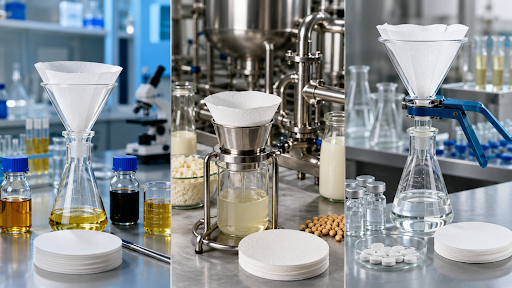
Few materials work as quietly and as critically as filter paper. It sits behind the scenes in a diagnostic lab, an edible oil refinery, a pharmaceutical QC unit, and a beverage bottling plant — yet very few people outside these industries stop to think about how much depends on its quality. If a filtration step fails, the ripple effects show up as contaminated products, inaccurate lab results, or compliance failures that can cost a business its reputation.
This guide breaks down how filter paper is used across major industries in India, what makes one grade different from another, and how to choose the right filter paper suppliers or filter paper manufacturers for your specific application.
What Makes Filter Paper Industry-Specific
Not all filter paper is interchangeable. The right choice depends on three factors: pore size, filtration speed, and chemical compatibility with the substance being filtered. A paper designed for coarse particle retention in oil testing will behave very differently from one designed for sterile filtration in a pharmaceutical lab.
Filter Paper in Oil Testing and Petroleum Labs
In oil testing, filter paper is used to separate solid contaminants — dust, metal particles, sludge — from lubricants, hydraulic fluids, and crude oil samples before they’re analyzed. This step directly affects the accuracy of contamination reports and equipment wear diagnostics.
Key requirements here include:
- High wet strength so the paper doesn’t tear under oil viscosity and vacuum filtration pressure
- Consistent pore size for repeatable, lab-grade results across batches
- Low fiber shedding to avoid introducing new contaminants into the sample
Refineries and industrial labs typically rely on qualitative or quantitative grades, chosen based on whether the goal is quick screening or precise gravimetric analysis.
Filter Paper in Food Processing
Food and beverage manufacturers use filter paper at multiple stages — clarifying oils, straining syrups, filtering dairy products, and testing raw ingredients for quality control. Here, the stakes shift from mechanical performance to food safety.
Food-grade filter paper needs to be:
- Non-toxic and chemically inert, so it doesn’t leach anything into the product
- FDA or equivalent food-safety compliant, especially for direct-contact applications
- Fast-draining, since production lines often can’t afford slow filtration cycles
This is one of the fastest-growing use cases for filter paper in India, driven by the expansion of packaged food, edible oil refining, and dairy processing sectors.
Filter Paper in Pharmaceutical Applications
Pharma is arguably the most demanding industry for filter paper. It’s used in raw material testing, API (active pharmaceutical ingredient) purification, sterility testing, and quality control across formulation stages. A single inconsistency in pore structure can compromise an entire batch’s compliance with pharmacopoeial standards.
Pharmaceutical-grade filter paper is expected to offer:
- Extremely low ash content, so it doesn’t interfere with gravimetric or chemical analysis
- High purity fiber composition, free from additives that could react with sensitive compounds
- Validated, batch-consistent performance to meet GMP and regulatory documentation requirements
Because pharma manufacturing is tightly audited, sourcing from a reliable, quality-consistent supplier isn’t optional — it’s a compliance requirement.
Other Industries Where Filter Paper Plays a Critical Role
Beyond these three, filter paper is widely used across:
- Chemical and water testing laboratories for sample preparation and effluent analysis
- Paints, inks, and coatings manufacturing to filter out impurities before packaging
- Agriculture and seed testing labs, including germination and moisture analysis
- Environmental and pollution control labs, for particulate matter and air quality testing
This versatility is exactly why choosing the right filter paper grade — rather than a generic one-size-fits-all option — matters so much for consistent, repeatable results.
How to Choose the Right Filter Paper Suppliers or Manufacturers
With so many grades and applications, sourcing decisions can get confusing fast. Here’s what genuinely reliable filter paper suppliers or filter paper manufacturers should offer:
- Application-specific grades — oil testing, food-grade, pharma-grade, and lab-grade papers should be clearly differentiated, not sold as interchangeable products.
- Consistent GSM, thickness, and pore size across batches, so results don’t vary from one production run to the next.
- Proper documentation and certifications, especially for food and pharma use cases where compliance paperwork is non-negotiable.
- Custom sizing and specification support, since industrial buyers often need non-standard dimensions or filtration speeds.
- Reliable supply consistency, because stockouts or inconsistent quality can directly disrupt production schedules.
Laxmi Industries has built its reputation in the specialty paper manufacturing space by focusing on exactly these details — consistent quality, application-specific grades, and dependable supply for industries that can’t afford filtration failures. Businesses looking for dependable filter paper manufacturers in India can explore their range at laxmipaperind.com.
The Bottom Line
Filter paper may seem like a small, unremarkable product — but its role in oil testing, food processing, pharmaceuticals, and dozens of other industries is anything but minor. Choosing the correct grade, and sourcing it from a manufacturer that understands application-specific requirements, directly affects product safety, regulatory compliance, and lab accuracy.
Whether you’re running contamination tests on hydraulic oil, clarifying edible oil in a food plant, or validating raw materials in a pharma facility, the right filter paper isn’t a minor purchasing decision — it’s part of your quality control backbone.
Frequently Asked Questions
1. What is filter paper used for in industrial applications?
Filter paper is used to separate solid particles from liquids or gases. Industrially, it’s applied in oil contamination testing, food and beverage clarification, pharmaceutical quality control, and chemical or environmental lab analysis.
2. What’s the difference between qualitative and quantitative filter paper?
Qualitative filter paper is used for general filtration and visual analysis, while quantitative filter paper is manufactured with very low ash content, making it suitable for precise gravimetric and chemical analysis.
3. Is filter paper safe for food processing applications?
Yes, provided it’s food-grade certified. It should be non-toxic, chemically inert, and compliant with food-safety standards so it doesn’t affect the taste, safety, or composition of the product it filters.
4. Why is filter paper important in pharmaceutical manufacturing?
Pharma-grade filter paper ensures accurate raw material testing, API purification, and sterility testing. Its purity and consistency directly impact regulatory compliance and product safety.
5. How do I choose the right filter paper grade for oil testing?
Look for high wet strength, consistent pore size, and low fiber shedding. These properties ensure the paper holds up under filtration pressure without contaminating the oil sample.
6. What should I look for in reliable filter paper suppliers?
Reliable suppliers offer application-specific grades, consistent batch quality, proper certifications, custom specifications, and dependable supply timelines — all essential for uninterrupted production or lab work.
7. Can the same filter paper be used across multiple industries?
Generally, no. Each industry has different requirements for purity, chemical compatibility, and filtration speed, so using an industry-specific grade is important for accurate and safe results.
8. Where can I find trusted filter paper manufacturers in India?
Laxmi Industries, a specialty paper manufacturer, supplies filter paper for oil testing, food processing, pharma, and laboratory use across India. More details are available at laxmipaperind.com.
9. Does filter paper affect the accuracy of lab test results?
Yes. Inconsistent pore size or fiber shedding can introduce errors into test results, which is why lab-grade filter paper needs strict quality control during manufacturing.
10. What industries in India use filter paper the most?
Petroleum and oil testing labs, food and beverage manufacturing, pharmaceutical companies, chemical laboratories, and agricultural testing centers are among the largest users of filter paper in India.