
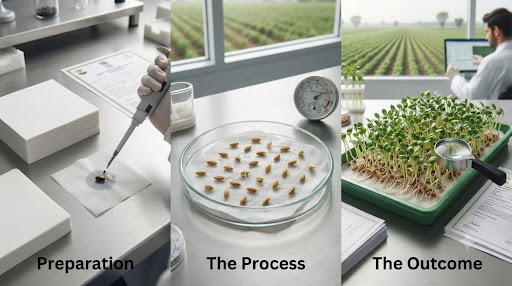
India’s agricultural story is being rewritten in laboratories and testing centers long before it ever reaches the field. Every high-yield crop, every certified seed batch, and every successful sowing season starts with a simple but often overlooked material: germination paper. While farmers, agri-input companies, and seed testing labs focus on hybrid varieties and soil health, the quality of the paper used to test seed viability plays an equally decisive role in determining what actually gets planted across the country.
As India pushes toward self-reliant agriculture and higher crop productivity, the demand for reliable, ISTA-compliant germination paper has grown sharply. And with that demand comes a critical question for seed companies, agri-research institutes, and testing laboratories: how do you choose the right germination paper suppliers for consistent, accurate results?
Why Germination Paper Is the Silent Backbone of Seed Testing
Germination paper isn’t just packaging or a testing accessory — it’s the medium that determines whether a seed’s viability report is accurate or misleading. Seed testing laboratories across India rely on this specialized paper to simulate natural soil moisture and temperature conditions, allowing technicians to observe root and shoot development under controlled settings.
Poor-quality paper can distort results in several ways:
- Uneven moisture retention leads to inconsistent germination rates
- Chemical residues or impurities can inhibit seedling growth
- Weak paper structure tears during root penetration, skewing observations
- Non-uniform thickness causes inaccurate imbibition rates
For an industry where a single percentage point in germination rate can influence purchasing decisions of thousands of farmers, this level of precision isn’t optional — it’s foundational.
The ISTA and AOSA Connection
Most seed testing labs in India follow protocols set by the International Seed Testing Association (ISTA) and the Association of Official Seed Analysts (AOSA). These bodies specify strict requirements for paper texture, water-holding capacity, pH neutrality, and fiber composition. Genuine germination paper manufactured to these standards ensures that test results are internationally comparable, which matters enormously for seed companies exporting to global markets or working with multinational agri-input firms.
What Makes a High-Quality Germination Paper
Not all paper labeled “germination paper” performs the same way under lab conditions. When evaluating options, seed testing professionals typically look at:
- Water absorption capacity — the paper must hold consistent moisture without becoming waterlogged
- pH neutrality — acidic or alkaline residues can chemically stress delicate seedlings
- Fiber strength — the sheet needs to resist tearing as roots and shoots develop
- Uniform thickness — inconsistent caliper leads to variable capillary action
- Chemical purity — free from bleaching agents or additives that interfere with germination
These aren’t abstract specifications — they directly affect whether a seed lot passes or fails quality checks, which in turn affects farmer trust, certification timelines, and ultimately, crop output across Indian farmland.
The Growing Demand for Germination Paper Suppliers in India
India’s seed industry has expanded rapidly over the past decade, driven by hybrid seed production, government-backed certification programs, and rising private investment in agri-research. This expansion has created strong, sustained demand for dependable germination paper suppliers who can deliver:
Consistent Quality at Scale
Large seed companies and government testing labs need suppliers who can maintain the same paper specifications across thousands of units, batch after batch. Variability between production runs undermines the entire purpose of standardized testing.
Timely and Pan-India Delivery
Seed testing operates on tight seasonal cycles tied to sowing calendars. A supplier’s ability to deliver across states — from Punjab’s wheat belts to Maharashtra’s cotton regions and Andhra Pradesh’s paddy fields — directly impacts a lab’s ability to meet certification deadlines.
Technical Support and Customization
Different crops require different paper grades. Fine seeds like mustard or sesame need finer-textured paper, while larger seeds like maize or groundnut require thicker, more absorbent sheets. Suppliers who understand these nuances and can guide customers toward the right product add real value beyond just selling paper.
How Specialty Paper Manufacturing Supports India’s Agricultural Goals
India’s push toward higher agricultural productivity, better seed certification infrastructure, and export-ready crop quality depends on a chain of supporting industries — and specialty paper manufacturing is one of the least visible but most essential links in that chain.
This is where established manufacturers like Laxmi Industries play a meaningful role. As a specialty paper manufacturer based in Hyderabad, Laxmi Industries produces seed germination paper alongside filter paper, pollination bags, and blotter paper — all engineered for the precision demands of agricultural and laboratory use. By focusing on consistent fiber quality, controlled absorption rates, and adherence to recognized testing standards, manufacturers in this space directly support the accuracy that seed labs, agri-research institutes, and certification bodies depend on every single day.
For laboratories and seed companies sourcing materials, working with a manufacturer that understands both the technical specifications and the practical realities of seed testing — rather than a generic paper trader — often makes the difference between reliable results and repeated retesting.
Beyond Germination Paper: A Broader Role in Agri-Testing
Specialty paper manufacturers serving the agricultural sector typically don’t stop at germination paper. Filter paper is essential for soil and water analysis, pollination bags protect controlled breeding programs from cross-contamination, and blotter paper supports various moisture-sensitive lab procedures. Together, these products form the material backbone of India’s seed quality assurance ecosystem — one that rarely gets attention but quietly enables everything from certified seed sales to crop research breakthroughs.
Choosing the Right Supplier: A Quick Checklist
Before finalizing a germination paper supplier, seed labs and agri-businesses should evaluate:
- Does the paper meet ISTA/AOSA specifications?
- Can the supplier provide consistent quality across bulk orders?
- Is there technical guidance available for crop-specific paper selection?
- What is the supplier’s track record with seed testing labs or certification agencies?
- Can they support pan-India delivery within seasonal timelines?
Getting these answers upfront saves labs from costly retesting cycles and protects the integrity of certification results.
The Bigger Picture
India’s agricultural future isn’t just being shaped by better seed genetics or precision farming technology — it’s also being shaped by the quality of the materials used to verify that seeds will actually grow as promised. Reliable germination paper, sourced from experienced germination paper suppliers, ensures that the entire seed certification pipeline — from lab bench to farmer’s field — rests on accurate, trustworthy data.
As India’s seed industry continues to scale, the labs and companies that prioritize testing material quality will be the ones best positioned to deliver consistent, high-performing seed varieties to farmers nationwide.
Frequently Asked Questions
1. What is germination paper used for?
Germination paper is a specialized absorbent paper used in seed testing laboratories to evaluate seed viability, germination rate, and seedling vigor under controlled moisture and temperature conditions.
2. Why is paper quality important in seed germination testing?
Paper quality directly affects moisture retention, chemical neutrality, and structural strength — all of which influence whether germination test results are accurate and repeatable.
3. What standards should germination paper meet?
Most Indian seed testing labs require germination paper that complies with ISTA (International Seed Testing Association) and AOSA (Association of Official Seed Analysts) guidelines for texture, absorption, and pH neutrality.
4. How do I choose the right germination paper suppliers?
Look for suppliers who offer ISTA-compliant products, consistent quality across bulk orders, technical guidance for crop-specific selection, and reliable pan-India delivery.
5. Does germination paper thickness matter?
Yes. Different seed types require different paper thickness — finer seeds need lighter, finer-textured paper, while larger seeds require thicker, more absorbent sheets to support proper moisture uptake.
6. Is germination paper the same as blotter paper?
They serve related but distinct purposes. Germination paper is specifically designed for seed viability testing, while blotter paper is used more broadly across various moisture-sensitive laboratory applications.
7. Can germination paper be customized for different crops?
Yes, reputable manufacturers offer variations in thickness, absorbency, and size to suit different seed categories, from fine seeds like mustard to larger seeds like maize and groundnut.
8. Who typically uses germination paper in India?
Seed testing laboratories, agricultural research institutes, seed certification agencies, and private seed companies across India rely on germination paper for quality control.
9. Why does supplier reliability matter for seed labs?
Seed testing follows strict seasonal cycles. A supplier’s ability to deliver consistent quality on time directly impacts a lab’s certification timelines and overall testing accuracy.
10. Where can I source high-quality germination paper in India?
Manufacturers like Laxmi Industries (laxmipaperind.com), based in Hyderabad, produce specialty germination paper along with filter paper, pollination bags, and blotter paper tailored to agricultural and laboratory testing needs across India.