
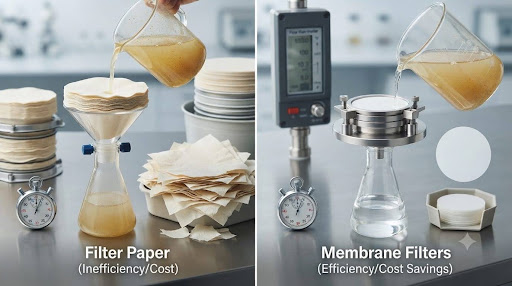
Every industrial procurement team eventually faces the same question: should we invest in membrane filters, or does traditional filter paper deliver the same performance at a fraction of the cost? It’s a decision that affects everything from lab budgets to production line efficiency, and the answer isn’t always as obvious as manufacturers of premium membrane systems would like you to believe.
For industries across India — from pharmaceuticals and food processing to chemical manufacturing and water treatment — filtration costs add up fast, especially when consumables are used daily. Understanding where filter paper for industrial use genuinely outperforms membrane filters, and where it doesn’t, can save procurement teams significant money without compromising filtration quality.
Understanding the Core Difference
Filter paper and membrane filters both separate solids from liquids or gases, but they work in fundamentally different ways.
Filter paper is made from cellulose or cellulose-blend fibers, relying on a network of interwoven fibers to trap particles as liquid passes through. Membrane filters, on the other hand, use a thin polymeric film with precisely engineered pore sizes to achieve much finer, more uniform filtration.
This structural difference drives everything else — cost, durability, filtration precision, and suitability for specific industrial applications.
When Filter Paper Wins
- General-purpose filtration where extremely fine pore precision isn’t required
- High-volume, repetitive filtration tasks where cost-per-use matters
- Applications involving larger particulates, such as sediment removal or coarse clarification
- Budget-sensitive operations that filter large quantities daily
When Membrane Filters Win
- Sterile filtration requiring bacteria or virus-level pore precision
- Highly sensitive pharmaceutical or biotech applications
- Situations requiring exact, certified pore-size consistency
The Real Cost Comparison
This is where the decision usually comes down to numbers. Membrane filters are engineered products with tight manufacturing tolerances, and that precision comes at a price — often several times higher per unit than comparable filter paper.
Cost Factors to Consider
- Unit price: Membrane filters typically cost 3–10x more per piece than standard filter paper
- Replacement frequency: Filter paper may need more frequent replacement in high-particulate applications, but the per-unit cost remains low
- Bulk purchasing potential: Bulk filter papers offer significant per-unit savings that membrane filters rarely match at comparable volumes
- Waste disposal: Paper-based filters are generally easier and cheaper to dispose of than polymer membrane waste
- Equipment compatibility: Filter paper works with standard, low-cost filtration setups, while membrane systems often require specialized housings
For industries running continuous or high-frequency filtration — think beverage production, oil and lubricant filtration, or laboratory testing at scale — the cumulative savings from choosing filter paper over membrane filters can be substantial over a fiscal year.
Where Bulk Purchasing Changes the Equation
Procurement teams that switch to bulk filter papers unlock a pricing advantage that’s difficult to replicate with membrane filters, which are rarely discounted as steeply at scale due to their more complex manufacturing process.
Advantages of Buying Filter Paper in Bulk
- Lower per-unit cost as order volume increases
- Reduced procurement overhead from fewer, larger orders
- Consistent quality across a single large production batch
- Simplified inventory management for high-consumption facilities
For manufacturing units, testing laboratories, and processing plants that use filtration daily, bulk sourcing isn’t just a convenience — it’s often the single biggest lever for reducing overall filtration costs.
Filter Paper for Industrial Use: What to Look For
Not all filter paper performs equally across industrial applications. When evaluating suppliers, industrial buyers should assess:
- Particle retention rating — matched to the specific application’s filtration needs
- Wet strength — the paper must maintain structural integrity under liquid flow without tearing
- Flow rate — faster filtration reduces processing time in high-volume operations
- Chemical compatibility — resistance to the specific solvents, oils, or chemicals being filtered
- Consistency across batches — critical for industries with strict quality control requirements
Industrial buyers who skip this evaluation often end up with premature filter failure, inconsistent flow rates, or contamination issues — all of which erase any cost savings gained from choosing paper over membrane in the first place.
Industries That Benefit Most from Filter Paper
Food and Beverage Processing
Clarification of juices, oils, and beverages often doesn’t require membrane-level precision, making filter paper a cost-effective standard choice.
Oil and Lubricant Filtration
Removing sediment and particulates from industrial oils is a high-volume, continuous process where filter paper’s cost efficiency delivers real operational savings.
Chemical and Water Treatment Facilities
Many chemical processing and preliminary water treatment steps rely on filter paper for coarse to medium filtration before finer polishing steps occur.
Laboratory and Quality Control Testing
Routine lab filtration for sample preparation, particulate analysis, and general testing frequently uses filter paper due to its reliability and lower cost per test.
Making the Right Choice for Your Industry
The membrane vs. filter paper decision shouldn’t be a blanket policy — it should be application-specific. A useful framework:
- Identify the required filtration precision — does the application genuinely need membrane-level pore control?
- Calculate cost-per-use at your actual volume — factor in both unit price and consumption frequency
- Evaluate bulk sourcing options — significant savings often come from switching to bulk filter paper procurement
- Assess disposal and compatibility requirements — paper is typically simpler and cheaper across both factors
For most general industrial filtration needs across India — where extreme sterile precision isn’t the primary requirement — filter paper consistently delivers comparable performance at meaningfully lower cost.
Sourcing Reliable Filter Paper for Industrial Applications
Cost savings only materialize if the filter paper itself performs consistently. This is where working with an experienced specialty paper manufacturer matters. Laxmi Industries, based in Hyderabad, manufactures filter paper alongside seed germination paper, pollination bags, and blotter paper — each engineered for the specific demands of industrial, agricultural, and laboratory use. For businesses evaluating filter paper for industrial use or looking to source bulk filter papers at scale, working directly with a manufacturer rather than an intermediary trader typically results in better consistency, more competitive bulk pricing, and fewer supply disruptions.
Final Thoughts
There’s no universal winner between filter paper and membrane filters — the right choice depends entirely on your industry’s filtration precision requirements and consumption volume. But for the vast majority of general industrial applications across India, filter paper offers a compelling combination of proven performance and substantial cost savings, especially when sourced in bulk from a reliable manufacturer.
Frequently Asked Questions
1. Is filter paper cheaper than membrane filters?
Yes, filter paper is typically 3–10 times less expensive per unit than membrane filters, making it significantly more cost-effective for high-volume industrial filtration.
2. When should an industry choose membrane filters over filter paper?
Membrane filters are better suited for applications requiring sterile, bacteria-level, or precisely certified pore-size filtration, such as pharmaceutical or biotech processes.
3. What industries commonly use filter paper for industrial use?
Food and beverage processing, oil and lubricant filtration, chemical manufacturing, water treatment, and laboratory testing all rely heavily on industrial filter paper.
4. Does buying bulk filter papers actually reduce costs?
Yes, bulk filter papers offer notable per-unit savings and reduce procurement overhead, making them one of the most effective ways to lower ongoing filtration costs.
5. What should I check before choosing an industrial filter paper supplier?
Look at particle retention rating, wet strength, flow rate, chemical compatibility, and consistency across production batches.
6. Can filter paper handle high-volume industrial filtration?
Yes, filter paper is well-suited to high-volume, continuous filtration tasks, particularly where extremely fine pore precision isn’t required.
7. Is filter paper as effective as membrane filters for general filtration?
For general-purpose applications like sediment removal, clarification, and coarse-to-medium filtration, filter paper performs comparably to membrane filters at a lower cost.
8. How does filter paper compare in terms of waste disposal?
Filter paper is generally easier and cheaper to dispose of than polymer membrane waste, adding an additional cost advantage for high-consumption facilities.
9. Does filter quality affect industrial cost savings?
Yes, inconsistent or low-quality filter paper can lead to premature failure or contamination, which offsets any initial cost savings — sourcing from a reliable manufacturer matters.
10. Where can I source bulk filter papers for industrial use in India?
Manufacturers like Laxmi Industries (laxmipaperind.com), based in Hyderabad, produce filter paper for industrial use along with germination paper, pollination bags, and blotter paper for businesses across India.