
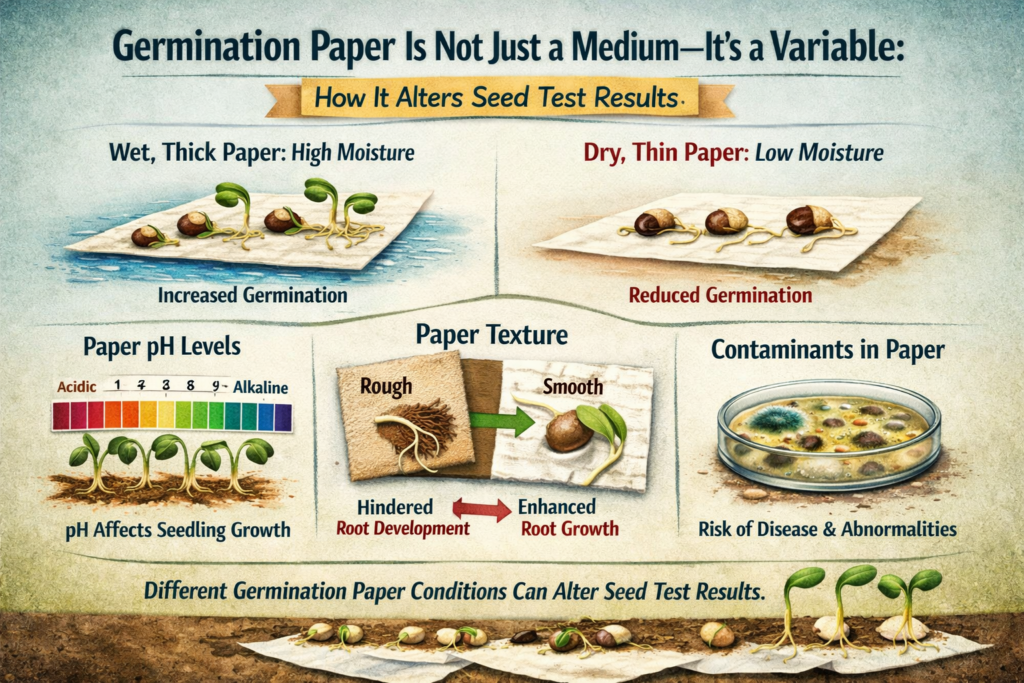
Most seed laboratories treat germination paper as a passive substrate. The science says otherwise — and the results prove it.
When you think about seed germination testing, what comes to mind? Controlled temperature chambers, precise humidity levels, standardized lighting schedules? These are all critical — but there’s one variable that routinely gets overlooked: the germination paper itself.
Ask any experienced seed analyst, and they’ll tell you—not all germination paper performs the same. The substrate you choose doesn’t just hold the seed in place. It actively influences moisture retention, oxygen availability, pH balance, and even chemical interactions. In short, germination paper is a variable, not just a medium.
At Laxmi Industries, we’ve spent years working with seed laboratories, agri-research institutions, and quality testing units across India to understand exactly how germination paper quality shapes test outcomes. What we’ve found is both eye-opening and actionable.
What Makes Germination Paper Different from Ordinary Paper?
Germination paper—also called seed germination blotter or germination blotter paper—is a specially engineered substrate designed to support seed viability testing. Unlike regular filter paper or tissue paper, it’s manufactured to meet very specific agronomic and chemical requirements.
The key properties that define high-quality germination paper include controlled water absorption capacity, neutral to slightly acidic pH, freedom from toxic substances, appropriate tensile strength when wet, and uniform thickness and porosity. Each of these properties directly affects how a seed behaves during the test window — and if any one of them is off, your results may not reflect the true germination potential of the seed lot.
The Moisture Factor: A Delicate Balance
One of the most direct ways germination paper influences test results is through its water-holding capacity. Seeds require consistent moisture — not waterlogged conditions, not dry pockets. The germination paper must act like a reliable reservoir that delivers moisture steadily throughout the test period.
Papers with inconsistent fiber density or poor manufacturing quality tend to absorb water unevenly. This creates “wet zones” and “dry zones” on the same test sheet. Seeds placed on dry zones may fail to germinate entirely, while those on wet zones may exhibit abnormal seedling development due to anaerobic conditions. The result? A germination percentage that doesn’t reflect the actual seed batch quality.
High-quality germination blotter paper maintains 2.5–3.5 times its own weight in water—a specification that Laxmi Industries’ germination paper consistently meets to support ISTA and AOSA-compliant testing protocols.
pH and Chemical Purity: The Hidden Influencers
Here’s something most seed testing textbooks don’t emphasize enough: the pH of your germination paper can actively inhibit seed germination. Most seeds germinate optimally in a slightly acidic to neutral environment — roughly pH 6.0 to 7.0. If your germination paper has a pH outside this range due to chemical residues from manufacturing, you’re introducing an invisible bias into your test.
Chemical contamination is another concern. Some lower-quality germination papers are produced using chlorine bleaching processes that leave trace residues of toxic compounds. These residues — even at parts-per-million concentrations — can inhibit root tip development or disrupt enzymatic activity in the seed embryo. The germination test may then falsely suggest poor seed quality when, in reality, the seed lot is perfectly viable.
Laxmi Industries’ germination paper is manufactured using processes that ensure pH neutrality and freedom from phytotoxic substances — a non-negotiable standard for any laboratory serious about accurate, reproducible testing.
Porosity, Airflow, and Why Seeds Need to Breathe
Germination is an aerobic process. Seeds require oxygen to activate cellular respiration and mobilize stored energy reserves. The porosity of germination paper plays a critical role in ensuring adequate oxygen exchange between the seed and its environment.
Dense or poorly structured paper can create a seal around seeds, cutting off airflow. Over a 7 to 28-day germination test period, this oxygen deprivation can significantly suppress germination rates or lead to abnormal seedling development. Many laboratories that switch to higher-quality, correctly porous germination paper report visible improvements in germination uniformity across test replicates.
Structural Integrity: Why Wet Strength Matters
There’s a practical dimension to germination paper quality that often gets overlooked until it causes a problem in the lab: wet tensile strength. A germination blotter that disintegrates when saturated, tears when roots penetrate it, or loses shape during the test period creates real-world handling problems and compromises data integrity.
High wet-strength germination paper holds its structure throughout the full test duration. This allows root systems to develop naturally without paper fragmentation interfering with seedling evaluation. It also means analysts can transfer germinated seeds for further evaluation without the substrate falling apart in their hands.
Standardization Matters: ISTA and AOSA Protocols
International Seed Testing Association (ISTA) and Association of Official Seed Analysts (AOSA) protocols specify germination paper requirements for a reason—because they understand that the substrate is a variable. Approved germination papers must meet defined specifications for water absorption, pH, and freedom from toxic substances.
Using non-compliant or substandard germination paper doesn’t just affect result accuracy — it undermines the entire standardization framework that allows seed test results to be compared across laboratories, regions, and seasons. For seed companies, agricultural research institutions, and national certification bodies, this comparability is everything.
ISTA Rule 5.4 specifically outlines that germination substrates must not contain any substances that are inhibitory or stimulatory to germination. Laxmi Industries’ germination paper is manufactured in alignment with these international standards.
Choosing the Right Germination Paper for Your Laboratory
If you’re sourcing germination paper for your seed testing laboratory, here are the key things to evaluate before making a decision:
Water absorption rate — Does the paper absorb and retain moisture uniformly? Ask for technical data sheets that confirm absorption specifications.
pH specification—Is the paper tested and certified to be within the 6.0–7.0 range?
Chemical certifications — Is it free from chlorine residues, heavy metals, and other phytotoxic substances?
Wet tensile strength — Will it hold up through a 28-day germination test without disintegrating?
Thickness and grammage consistency — Uniform thickness ensures consistent seed-to-moisture contact across the test area.
These aren’t just quality assurances — they are the parameters that protect the scientific validity of your germination testing program.
The Laxmi Industries Difference
At Laxmi Industries, germination paper isn’t a commodity product—it’s a precision-engineered testing tool. Our manufacturing facility produces germination blotter paper that meets rigorous quality benchmarks across moisture retention, pH, chemical purity, and structural integrity.
We supply germination paper to seed companies, government testing laboratories, agricultural universities, and export-quality certification bodies across India and internationally. Our products are trusted because they deliver consistent, reproducible results—which is ultimately what every seed testing laboratory is working toward.
Whether you’re testing wheat, paddy, cotton, vegetable seeds, or hybrid varieties, the substrate you choose sets the foundation for data you can rely on. Visit us at laxmipaperind.com to explore our full product range.
Conclusion: Treat Your Substrate as a Test Parameter
The next time you set up a germination test, think of the germination paper not as background material, but as one of the most influential parameters in your experimental setup. It affects moisture delivery, chemical environment, oxygen availability, and structural support — all of which shape the germination data your laboratory produces.
Choosing the right germination paper isn’t an administrative decision. It’s a scientific one. And in seed testing, where accuracy determines the livelihoods of farmers and the integrity of food systems, it’s a decision worth getting right.
Ready to upgrade your germination testing? Connect with the team at Laxmi Industries today to request product samples, technical data sheets, or bulk pricing — laxmipaperind.com
Frequently Asked Questions (FAQs)
Q1. What is germination paper, and why is it used in seed testing?
Germination paper, also known as germination blotter paper, is a specially manufactured substrate used to support seeds during viability and germination testing. It is designed to absorb and hold moisture evenly, maintain a neutral pH, and provide adequate airflow around the seed. Seed testing laboratories use germination paper because it creates a controlled, standardized environment that allows accurate measurement of germination percentage and seedling quality—results that cannot be reliably obtained using ordinary paper or filter paper.
Q2. How does the quality of germination paper affect seed test results?
The quality of germination paper directly impacts the accuracy of seed test results in several ways. Poor water absorption leads to uneven moisture distribution, causing some seeds to fail germination due to dryness while others develop abnormally in waterlogged areas. An incorrect pH or chemical contamination from manufacturing residues can inhibit root and shoot development, making healthy seeds appear non-viable. Low wet tensile strength causes the paper to disintegrate during testing, interfering with seedling evaluation. In contrast, high-quality germination paper from manufacturers like Laxmi Industries ensures consistent results that truly reflect the seed lot’s germination potential.
Q3. What standards should germination paper meet for laboratory use?
Germination paper used in accredited seed testing laboratories should comply with ISTA (International Seed Testing Association) and AOSA (Association of Official Seed Analysts) specifications. These standards require that germination paper maintains a water absorption capacity of approximately 2.5 — 3.5 times its dry weight, has a pH in the range of 6.0–7.0, is free from phytotoxic substances such as chlorine residues or heavy metals, and maintains adequate porosity for oxygen exchange. Laxmi Industries manufactures germination paper that aligns with these international standards, making it suitable for both domestic and export-grade seed certification programs.